
Master of Arts in Interdisciplinary Studies
Introduction
This unique degree allows students to study two or three fields of study (called concentrations) and to reflect on the interconnections between and across their chosen concentrations.
This degree serves many different types of students:
- aspiring community college-level instructors or instructors who want to expand their knowledge, expertise, and credentialing
- licensed K-12 teachers who want to enhance their content knowledge and advance within their career
- individuals across many careers for whom the MA degree will result in increased pay and opportunities
- life-long learners who enjoy academic scholarship or for whom a graduate degree has always been an aspiration
Create Your Degree, Your Way!
The Master of Arts in Interdisciplinary Studies requires 36 credit hours of graduate-level coursework for a first graduate degree or 30 hrs for a subsequent graduate degree.
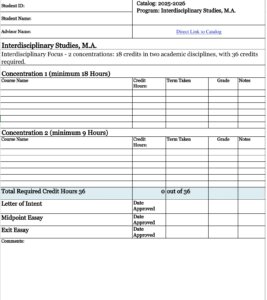
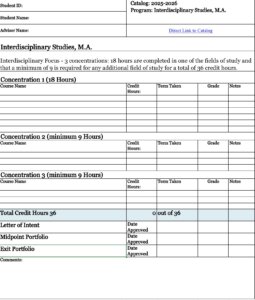
For this degree, you select 2 or 3 academic disciplines, called concentrations. A minimum of 9 credit hours is required for each concentration. Additionally, we recommend a minimum of 18 credits for at least one concentration.
MA Degree Plan with 2 Concentration Areas
MA Degree Plan with 3 Concentration Areas
MA Concentrations List and Faculty Mentor Contact Information
Department website: https://coe.wnmu.edu/
Bilingual Education (BLED)
Dr. Alexandra Neves
Alexandra.Neves@wnmu.edu
Martinez Building, room 213 D
(575) 538-6332
Early Childhood Education
(575) 538-6486
Elementary Education
For students with last names beginning A-I
Dr. Margarita Wulftange
Margarita.Wulftange@wnmu.edu
Martinez Building, room 212C
(575) 538-6551
For students with last names beginning J-R
Melissa Teller
Melissa.Teller@wnmu.edu
For students with last names beginning S-Z
Dr. Manuel Bustamante
Manuel.Bustamante@wnmu.edu
Martinez Building, room 212B
(575) 538-6291
Instructional Design
Dr. Manuel Bustamante
Manuel.Bustamante@wnmu.edu
Martinez Building, room 212B
(575) 538-6291
Reading Education
Dr. Catherine Gregorius
Catherine.gregorius@wnmu.edu
Martinez Building, room 209
(575) 538-6419
Secondary Education
Dr. Stephanie Fanselow
Stephanie.Fanselow@wnmu.edu
Spanish
Dr. Gregory Robinson Guerra
Gregory.Robinsonguerra@wnmu.edu
Martinez Building, room 210
(575) 538-6414
Department website: https://humanities.wnmu.edu/
English
Dr. Chris Taylor
Christopher.Taylor@wnmu.edu
Bowden Hall, room 215
Philosophy
Dr. Phillip Schoenberg
Phillip.Schoenberg@wnmu.edu
Bowden Hall, room 214
(575) 538-6347
Writing
Dr. Heather Steinmann
Heather.Steinmann@wnmu.edu
Department website: https://mathcs.wnmu.edu/
Mathematics
Dr. Scott Smith
Scott.Smith@wnmu.edu
Global Resources Center, room 214
(575) 538-6255
Department website: https://natsci.wnmu.edu/
Biology
Dr. William “Bill” Norris
William.Norris@wnmu.edu
Harlan Hall, Room 142
(575) 538-6625
Geographic Information Systems and Science
Dr. Kathy Whiteman
Kathleen.Whiteman@wnmu.edu
Harlan Hall, Room 112
(575) 538-6253
Department website: https://socialsciences.wnmu.edu/
History
Dr. Andy Hernandez
Andy.Hernandez@wnmu.edu
(575) 538-6212
Latino & Latin American Studies
Dr. Andy Hernandez
Andy.Hernandez@wnmu.edu
(575) 538-6212
Political Science
Dr. Joel Blaxland
Joel.Blaxland@wnmu.edu
Email to schedule appointment:
https://wnmu.zoom.us/j/7379925765
Sociology
Dr. Dara Naphan-Kingery
Dara.Naphan-Kingery@wnmu.edu
Global Resource Center, room 203
(575) 538-6824
Dr. Andreea Nica
Andreea.Nica@wnmu.edu
Email to schedule appointment:
https://wnmu.zoom.us/j/5035740421
Department website: https://behavioral.wnmu.edu
Criminal Justice
Dr. Damon Bullock
Damon.Bullock@wnmu.edu
Phelps Dodge, room 237
(575) 538-6187
Psychology
Dr. Po-sen “Mark” Chu
Po-sen.Chu@wnmu.edu
Phelps Dodge, room 137
(575) 538-6528
Department website: https://sb.wnmu.edu/
Business Administration
Dr. Ivan Ibarra Sanchez
ibarrasanchez@wnmu.edu
Phelps Dodge, room 137
(575) 538-6331
Business Management
Dr. Ivan Ibarra Sanchez
ibarrasanchez@wnmu.edu
Phelps Dodge, room 137
(575) 538-6331
Management Information Systems
Dr. Ivan Ibarra Sanchez
ibarrasanchez@wnmu.edu
Phelps Dodge, room 137
(575) 538-6331
Department Website: https://sonak.wnmu.edu/undergrad-kinesiology/
Kinesiology
Dr. Garrett Peltonen
Garrett.Peltonen@wnmu.edu
Phelps Dodge, room 134
(575) 538-6451
Dr. Takahiro Sato
Takahiro.Sato@wnmu.edu
(575) 538-6861
Master of Interdisciplinary Studies Learning Outcomes
By the end of their program, students should be able to
1. Incorporate and elucidate major theories, research methods, and approaches to inquiry in their fields of study, applying major methodologies and practices to projects, papers, exhibits, or performances. Demonstrate measurable analytical and critical ability over numerous assignments of various kinds in one or more disciplines. (WNMU Degree Level Outcome #1)
2. Disaggregate, reformulate and adapt principal ideas, techniques or methods at the forefront of Interdisciplinary Studies scholarship in carrying out an essay or project. (WNMU Master’s Degree Level Outcome #2).
- Articulate the interdisciplinary nature of their degree by examining how their concentrations interconnect and inform one another.
- Apply Interdisciplinary Studies scholarship to reflect their understanding of interdisciplinary studies as it relates to their learning path and concentrations.
3. Demonstrate effective communication by creating coherent arguments and explanations of original individual and/or collaborative work and presenting them error-free to general and specialized audiences (WNMU Master’s Degree Level Outcome #6)
Program Requirements
Letter of Intent
A Letter of Intent is required of all students seeking a Master of Interdisciplinary Studies degree. You cannot be admitted into the MAIS program until your letter has been approved by the program admissions committee. This Letter of Intent should be submitted AFTER you have become a “final admit.”
The letter of intent must
- explain how and why this master’s program will serve your educational, professional, and/or personal needs
- show a broad understanding of the field of Interdisciplinary Studies and how this fits your academic goals
- provide evidence of your preparation and motivation to be successful in the program
Specific guidelines for each of these programmatic requirements are located in the Interdisciplinary Studies Canvas course. You will be invited to join the course when you have received “final admit” status in Graduate Admissions.
Midpoint and Exit Portfolios
For the MA in Interdisciplinary Studies, the Midpoint and Exit portfolios offer you an opportunity to examine your coursework in separate concentrations within the context of interdisciplinary studies. This assignment allows you to reflect on your learning and offer you avenues for articulating to yourself and to others, including the program director and your employers (current and/or future), the value and purpose of your degree.
The Mid-Point portfolio should be submitted once you have completed 15-18 credit hours toward your MA degree.
The Exit portfolio should be submitted in your last semester of coursework.
Contact Information
For information about specific concentrations, contact the faculty mentors listed for those concentrations.
For information about Graduate Admissions, check out their homepage here: https://admissions.wnmu.edu/graduate/
For information about Interdisciplinary Studies, contact our office:

Dr. Katherine Oubre